
Your own store or a marketplace (third-party site): where to start
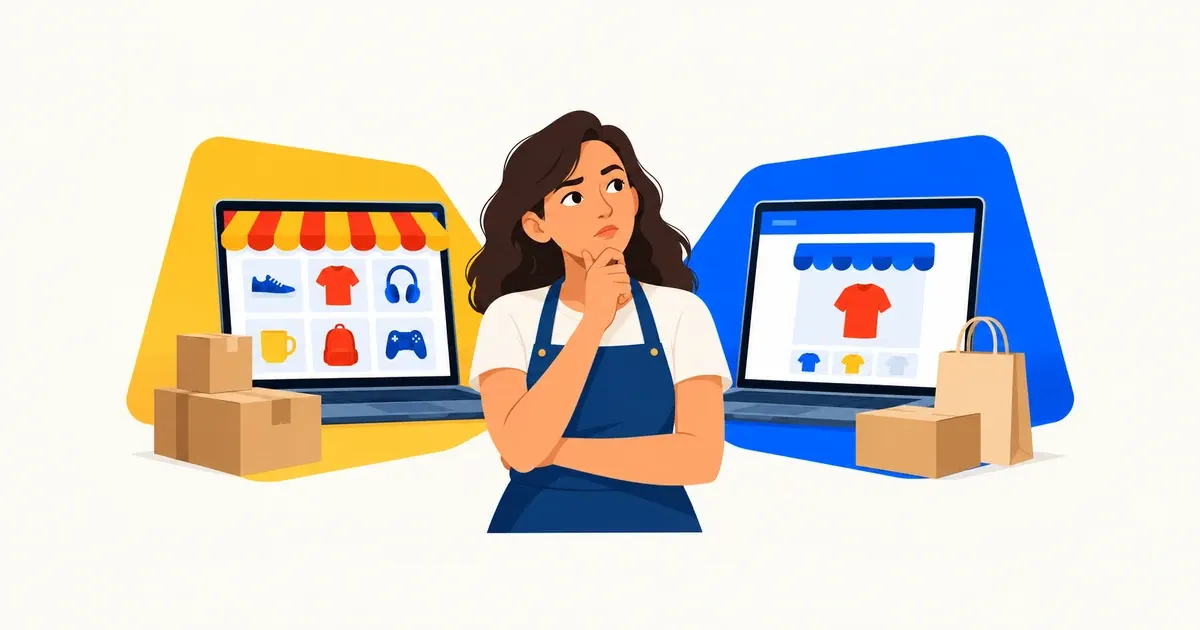
Photo: Avila Ops Tecnologia
It depends on whether customers search for the product or the brand. A marketplace (Mercado Livre, Shopee, Amazon, Magalu) brings ready customers and charges commission per sale; it works for testing demand and moving generic products. Your own store has no sales commission, keeps the customer relationship with you, and builds your brand, but requires you to bring traffic. Sellers offering products others also sell start with a marketplace; sellers offering their own or branded products start with their own store and use the marketplace as an additional showcase.
Choosing incorrectly costs months. Marketplace only means tight margins and customers who never knew your name. Your own store only, without a plan to attract people, means a beautiful, empty store.
What does each provide and charge?
Photo: Avila Ops Tecnologia
| Marketplace | Your own store | |
|---|---|---|
| Customer | Already there, searching | You need to bring them (Google, Instagram, ads, WhatsApp) |
| Cost per sale | Category-based commission set by the marketplace, plus shipping fees on some | Payment intermediary fee; at Avila Ops, no platform commission |
| Fixed cost | Usually none or low (Amazon charges a monthly fee for its professional plan) | Monthly fee (R$ 79 to R$ 349 at Avila Ops) and setup |
| Customer data | Stays with the marketplace | Stays with you: email, phone, history |
| Brand | Your listing beside ten competitors, emphasizing price | Your store, your domain, your rules |
| Rules | The marketplace’s: deadlines, reputation, return policy, blocking | Yours, within the law |
| Competition | Direct, on the same screen | None within the website |
Commission percentages vary by marketplace and category; check each one’s fee table before setting prices. What does not change: in a marketplace, prices are compared on the same screen and margins tend to come under pressure; in your own store, the margin is yours, but attracting visitors is also your responsibility.
Where should you start, by product type?
The criterion that resolves most cases is this: does the customer search for the product or the brand?
- Generic products many sellers offer (phone cases, tools, replacement parts): customers search for the product and compare prices. Start in a marketplace, learn what sells, and open your own store when volume justifies the monthly fee.
- Your own or handmade products (original clothing, natural cosmetics, creative stationery): customers search for the brand, or will after seeing it on Instagram. Start with your own store connected to Instagram and WhatsApp, and use a marketplace as a secondary channel for people who have never heard of you.
- Local products or products with your own delivery (food, plants, furniture): your own store with pickup and delivery in the city. A national marketplace does not help.
- Thin-margin products: marketplace commission can wipe out the profit. Calculate the real cost of selling online, including commission, before listing.
How do you use both without losing control?
Anyone operating both channels needs three things:
- Unified inventory. Selling something on a marketplace that sold out in your own store (or vice versa) creates cancellations and hurts marketplace reputation. The same product record must update stock in both.
- Consistent pricing. Prices can differ (commission justifies it), but customers comparing them need to understand. Many stores price slightly higher in the marketplace and offer a Pix discount in their own store.
- A brand customers remember. Build your brand within what the marketplace allows: a name on the packaging, a well-made product, good reviews. A card with your website, Instagram, or WhatsApp inside the package violates most marketplaces’ rules (Amazon and Mercado Livre prohibit diverting buyers) and can suspend the account; check each policy. You also cannot use marketplace customer data for prospecting. People who like the brand search for it, and that is where your own store needs to appear.
What your own store does, and what distinguishes it from a catalog and a marketplace, is covered in what an online store is. If you are deciding between a store and selling only through Instagram, see website or Instagram for a small business.
What to do now
Answer in one line: does your customer search for your product or your brand? The answer tells you where to start. Then calculate margins with and without commission for your three best-selling products. Describe your business and we will put together a channel, store, and operations assessment, at our expense: avilaops.com/jornada or contact us on WhatsApp: wa.me/5517997811471.
Frequently asked questions
Is selling on Mercado Livre while having my own store worthwhile?
Yes, provided inventory is unified and pricing is consistent. The marketplace brings people who do not know the brand; your own store keeps those who have already bought. The mistake is operating both with separate spreadsheets.
How much does a marketplace charge per sale?
A commission on the value, varying by marketplace, category, and listing type, and in some cases a shipping or low-value sale fee. Check each one’s public fee table; it changes frequently.
Can I start my own store without Instagram?
Yes, but you will need another route for traffic: Google (Business Profile and pages Google understands), WhatsApp, referrals, ads. A store without a traffic plan stays empty, however good it is.
Connections, made clear
From order to delivery, with every step in view.
An example of connecting E-Commerce with your team’s day-to-day work.
- OrderThe customer chooses items and places an order.
- ValidationCheck the details and product availability.
- ManagementSend the validated order to ERP.
- FulfillmentThe team prepares and dispatches the items.
- CustomerKeep the customer informed about next steps.
- Order. The customer chooses items and places an order.
- Validation. Check the details and product availability.
- Management. Send the validated order to ERP.
- Fulfillment. The team prepares and dispatches the items.
- Customer. Keep the customer informed about next steps.
Order
The customer chooses items and places an order.
Turn what you learned into your next step.
Tell us about your company and what you want to improve. We can explore the right tools, integrations or custom project together.