
Discount codes: rules that prevent losses
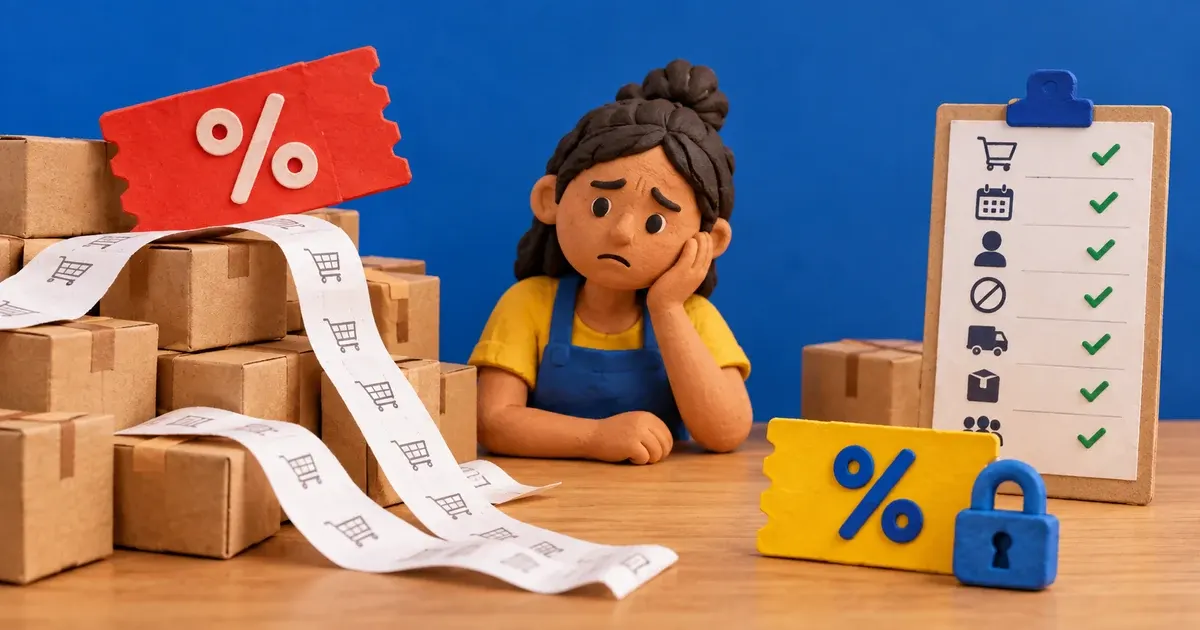
Photo: Avila Ops Tecnologia
A discount code only generates profit when it has limits. Seven rules fit any store: minimum order value, expiration date, single use per customer, no stacking with other promotions, no discount on shipping, no use on already discounted products, and a maximum number of redemptions. Without these safeguards, a code becomes a lower price for everyone, including people who were already going to buy.
For small businesses, discount codes are the easiest sales tool to create and the easiest to get wrong. A 20% code posted on Instagram without an expiration circulates in WhatsApp groups for months. Every sale that would have happened anyway gets discounted, and the entire month’s margin disappears without bringing in new customers.
What are the seven rules?

Photo: Avila Ops Tecnologia
Configure all of them before publishing the first code. Most platforms have ready-made fields.
| Rule | What it does | Why |
|---|---|---|
| Minimum order | Only applies above R$ X | Ensures the discount does not consume a small order’s margin |
| Expiration | End date and time | A code without an end becomes a permanent price |
| Single use per customer | One code, one purchase per CPF or email | Prevents the same customer using it ten times |
| No stacking | Cannot combine with another code or free shipping | Two discounts together can erase the margin |
| Excludes shipping | Discount applies only to products | Shipping is already a cost; discounting it creates a double loss |
| Excludes sale items | Products with a “now” price are excluded | A discount on a discount rarely adds up |
| Redemption limit | The first 50, for example | You know the maximum cost before publishing |
A code is a form of discount; the clear-information rules in “was” and “now” prices: when they help and when they become a lie apply to it too.
Which discount should you offer: percentage or fixed amount?
A percentage (10%) seems larger on expensive products and smaller on cheap ones. A fixed amount (R$ 20) seems large on small orders and disappears on large ones. In practice:
- High-value products or high average orders: a fixed amount. A fixed R$ 30 costs R$ 30 on any order; 10% costs R$ 30 on a R$ 300 order and R$ 50 on a R$ 500 order.
- Low average orders when you want to increase order value: a percentage with a minimum. “15% above R$ 150” encourages people planning to spend R$ 120 to add more.
- First purchase: a small fixed amount, single use. It is a known acquisition cost.
Before choosing the amount, calculate your average order: price minus product cost, processor fees, absorbed shipping, and tax. What remains is the discount ceiling. A code exceeding that sells at a loss.
How do you know whether the code generated sales or merely discounts?
A good code brings people who would not have bought; a bad one discounts people already coming. To distinguish them:
- Compare the code’s week with the previous week without it. If order count did not increase, the code merely lowered the price.
- Check how many code users were new customers. The platform shows whether their email had previous orders.
- Add up the total discount granted and divide by new orders. This is cost per new customer. Compare it with what you would pay for ads.
One use that usually passes all three measures: a recovery code for abandoned carts, valid for 48 hours. The guide abandoned carts: the three most common reasons explains when it makes sense.
Discount code or free shipping?
For customers, free shipping usually matters more than an equal-value discount because shipping is the cost they did not choose. For you, free shipping has a variable cost by ZIP code; a code has a fixed, predictable cost. If average orders are low and shipping is significant, free shipping above a minimum wins; the calculation is in free shipping above what amount? The calculation that decides. If shipping is already inexpensive, a code with a minimum order is simpler to control.
What to do now
List your store’s active codes and disable those without expiration or redemption limits. Then create just one with all seven rules and measure it for a week. A store live in one day, with configurable discount codes and no sales commission: avilaops.com/loja-virtual or contact us on WhatsApp: wa.me/5517997811471.
Frequently asked questions
What is the ideal discount code percentage?
Whatever your average order margin can support after fees, shipping, and tax. For many small stores, between 5% and 15% with a minimum order. Above that, check the calculation product by product.
Do first-purchase discount codes work?
Yes, when they are single-use, expire soon, and their value is what you are willing to pay for a new customer. Without these safeguards, they become a discount for anyone creating a new email address.
Can I cancel a code I already published?
You can disable it, but an advertised offer binds the advertiser (CDC, article 30). If it was advertised with an end date, honor that date. If it had no deadline, announce deactivation in advance.
Turn what you learned into your next step.
Tell us about your company and what you want to improve. We can explore the right tools, integrations or custom project together.