
Settlement time: why card payments take time
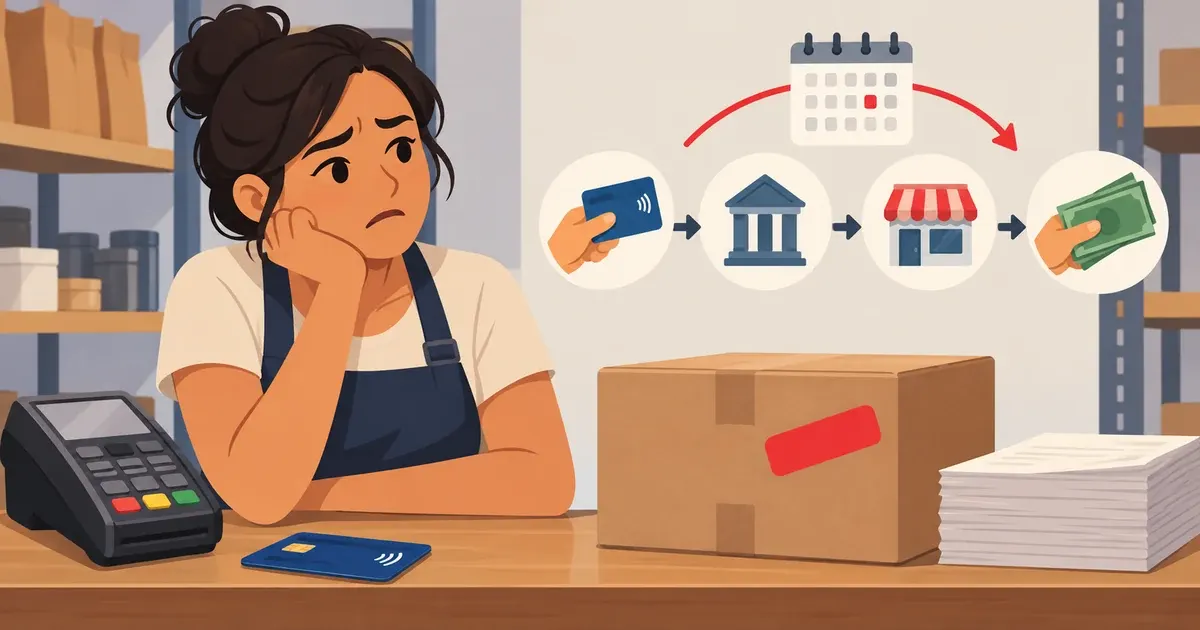
Photo: Avila Ops Tecnologia
Credit card money takes time because the customer’s bank only pays the acquirer about 30 days after purchase; it finances the customer until the bill. The acquirer transfers to the processor, which deposits according to your contract, generally 30 days for single-payment credit purchases. Debit and Pix arrive much sooner.
In practice, you sell today and pay suppliers before receiving money. That is the difference between revenue and cash. People who misunderstand timing think they are profitable while the account goes negative. Those who understand choose what to encourage and when advances are worthwhile.
Why does the delay exist?
Money makes four stops, explained in Who is who in online payments. What matters here is time at each:
- The customer buys today. Their bank approves but does not pay; it reserves the credit limit.
- For single-payment credit, the customer’s bank pays the acquirer about 30 days after purchase, regardless of the bill date. The card network defines rules and charges its fee but does not advance money.
- The acquirer transfers to the processor, which deposits under your contract.
- You receive on the agreed date: 30 days is most common for single-payment credit; some contracts offer 14 or fewer for a charge.
For installments, the customer’s bank pays one installment monthly. Depending on the contract, the processor pays you installment by installment or all at once with advance costs included in the fee. In the first case, a six-installment sale means six monthly deposits. With debit, money leaves the customer’s account immediately and generally arrives the next business day. Pix arrives instantly, making it most helpful for cash flow; What Pix does for a store explains its use.
What are receivables advances, and what do they cost?
An advance means asking the processor for money before its due date. It deducts a fee proportional to days advanced, like interest. There are two formats:
- Automatic: all sales arrive within one or two days, with the fee included in each. Simple, but you pay even when unnecessary.
- Occasional: request when needed, choosing installments to advance. More work, but costs apply only when needed.
Advance fees vary by processor and term; consult your processor’s public table. Without giving a number, monthly advances are a disguised fixed expense. If you always need them, prices are too low or supplier terms too short.
How can you protect cash without advances?
In most cases, this resolves it:
- Encourage Pix. A small Pix discount usually costs less than credit fees, and money arrives immediately. See the comparison “Pix, card or boleto: what each costs.”
- Limit interest-free installments. Every extra installment adds another month of waiting and cost.
- Negotiate supplier terms. Receiving in 30 days but paying in 28 leaves a two-day gap every cycle.
- Keep a reserve equal to one month of purchases. It absorbs the gap between selling and receiving.
If cash remains tight, occasionally advance larger installments and let the rest settle normally.
What to do now
Open the processor statement and record purchase dates and expected deposit dates for the last ten card sales. The gap is your actual settlement time. Compare it with supplier payment terms. A store with instant Pix, cards and boleto without platform commissions: avilaops.com/loja-virtual or contact us on WhatsApp: wa.me/5517997811471.
Frequently asked questions
How many days until card money arrives?
It depends on your processor contract. Thirty days is most common for single-payment credit. Debit usually arrives the next business day. Pix arrives immediately. Check the expected date for each sale in the processor dashboard.
Are receivables advances worthwhile?
When the advance costs less than being without the money, such as losing a supplier discount or paying overdraft interest. As a monthly routine, it eats margin.
Can I receive card payments the same day?
Yes, through automatic advances with the corresponding fee on every sale. Some processors offer shorter settlement plans with higher fees. Calculate annual costs before choosing.
Turn what you learned into your next step.
Tell us about your company and what you want to improve. We can explore the right tools, integrations or custom project together.