
Does requiring registration before purchase drive buyers away?

Photo: Avila Ops Tecnologia
It does. Requiring customers to create an account, with a password and email confirmation, before seeing payment options is among the most frequently cited reasons for cart abandonment in surveys (Baymard Institute, with US shoppers). The solution is not to stop collecting data: collect only what delivery and invoicing require, directly at checkout, and offer an account after the order is paid.
First-time buyers do not yet trust you enough to “open an account”; they want to pay and receive their order. Previous buyers accept an account because they have seen the store deliver. Make the sale first, then offer registration.
What does the store need to know to sell?
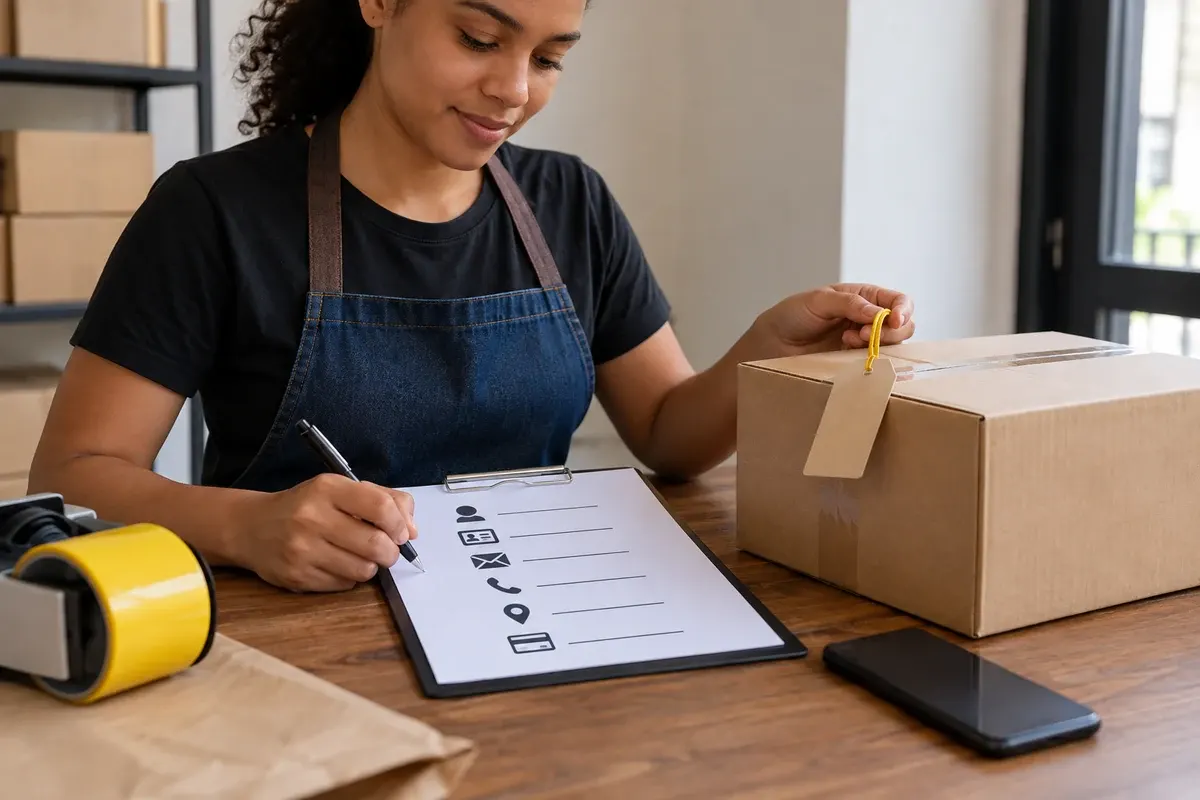
Photo: Avila Ops Tecnologia
Six pieces of information, each with a reason you can explain next to the field:
| Information | Purpose |
|---|---|
| Full name | Shipping label and tax invoice |
| CPF | Electronic tax invoice |
| Order confirmation and tracking | |
| Phone | Delivery notifications and contact if there is a problem |
| Address with postal code | Delivery and shipping calculation |
| Payment method | Complete the order |
What you do not need: a password, birth date, gender, “how did you hear about us,” or email confirmation before payment. Each can be requested later, with a reason, or never.
A customer account is useful for returning buyers: it saves addresses, displays orders, and simplifies exchanges. Offer it on the confirmation screen with a “create a password to track your order” button. Anyone who wants one can create it in a click because their details are already there.
How does buying without an account work?
Guest checkout uses the same six pieces of information and creates the order normally. The difference is that there is no password. Customers track orders through a link sent by email or WhatsApp and, if they return, enter their details again or create an account then.
Most platforms have a ready-made option called “guest checkout” or “checkout without registration.” Check that it is enabled and test on a phone as a new customer, counting the fields. If a field appears that is not in the table above, something is unnecessary. The guide what checkout is and why it decides the sale covers everything else checkout needs.
There is an exception: stores selling only to businesses, with CNPJ-based pricing and invoicing, or those requiring customer approval first (wholesale, controlled products). In these cases registration is part of the business and customers expect it. For consumer sales, it is not.
What does the LGPD require for this registration?
Brazil’s General Data Protection Law applies to every business collecting personal information, including small stores. Four practical checkout rules:
- Request only what is necessary for the purpose (selling and delivering). Asking for a birth date “for birthday messages” without customer agreement collects information beyond that purpose.
- Say what it is for. A line beside the field (“CPF for the tax invoice”) does the job.
- Have a privacy policy linked at checkout, explaining what you store, for how long, and how customers request deletion.
- Do not use the phone number for promotions without consent. A number provided for delivery does not authorize promotional messages: without separate consent, they are hard to justify under the LGPD and violate WhatsApp Business policy. An unchecked-by-default box saying “I want to receive updates through WhatsApp” addresses this.
The guide how to use AI in customer service without violating the LGPD goes deeper into handling data in customer interactions.
How do you offer an account without driving people away?
Three moments work, all after payment:
- On the confirmation screen: “Create a password to track this and future orders.” One field, one button.
- In the shipping email: a tracking link leading to optional account creation.
- On the second purchase: checkout recognizes the email and asks whether they want to use the saved address.
The account becomes a benefit rather than a toll. And customers who create passwords after receiving their products are the ones who will use them. Other reasons for abandonment, and the order in which to fix them, are in abandoned carts: the three most common reasons.
What to do now
Open your store on a phone in a private window and try to buy. If “create an account” appears before payment, enable guest checkout today. Count the fields and remove any without a reason. Get a store live in one day, with guest checkout, optional accounts, and a privacy policy at checkout, with no sales commission: avilaops.com/loja-virtual or contact us on WhatsApp: wa.me/5517997811471.
Frequently asked questions
Is requesting a CPF mandatory in an online store?
To issue a consumer tax invoice, the CPF identifies the buyer. Request it at checkout and explain that it is for invoicing. It is not required to browse or calculate shipping.
Is guest checkout safe for the store?
Yes. The order has the same delivery and payment information; it simply has no password. Payment security comes from the processor, not registration. The difference is that customers have no saved history.
Can I request a phone number and use it for promotions?
Only with explicit, separate consent, such as an initially unchecked box the customer checks. A phone number provided for delivery is for delivery. Separate consent is the safe approach under the LGPD; without it, promotional messages are hard to justify and violate WhatsApp Business policy.
Turn what you learned into your next step.
Tell us about your company and what you want to improve. We can explore the right tools, integrations or custom project together.