
Delivery times: how to make promises you can keep

Photo: Avila Ops Tecnologia
A reliable delivery promise adds three parts: your picking and dispatch time, the carrier’s delivery time, and a buffer for problems. State it in business days, starting from payment approval, and show it before customers pay. Businesses promising only carrier transit times often run late without understanding why.
Calculate twice: once for an ordinary month and once for Black Friday, when picking time doubles and carriers take longer. Better to promise seven days and deliver in five than the reverse.
How do you calculate actual delivery time?
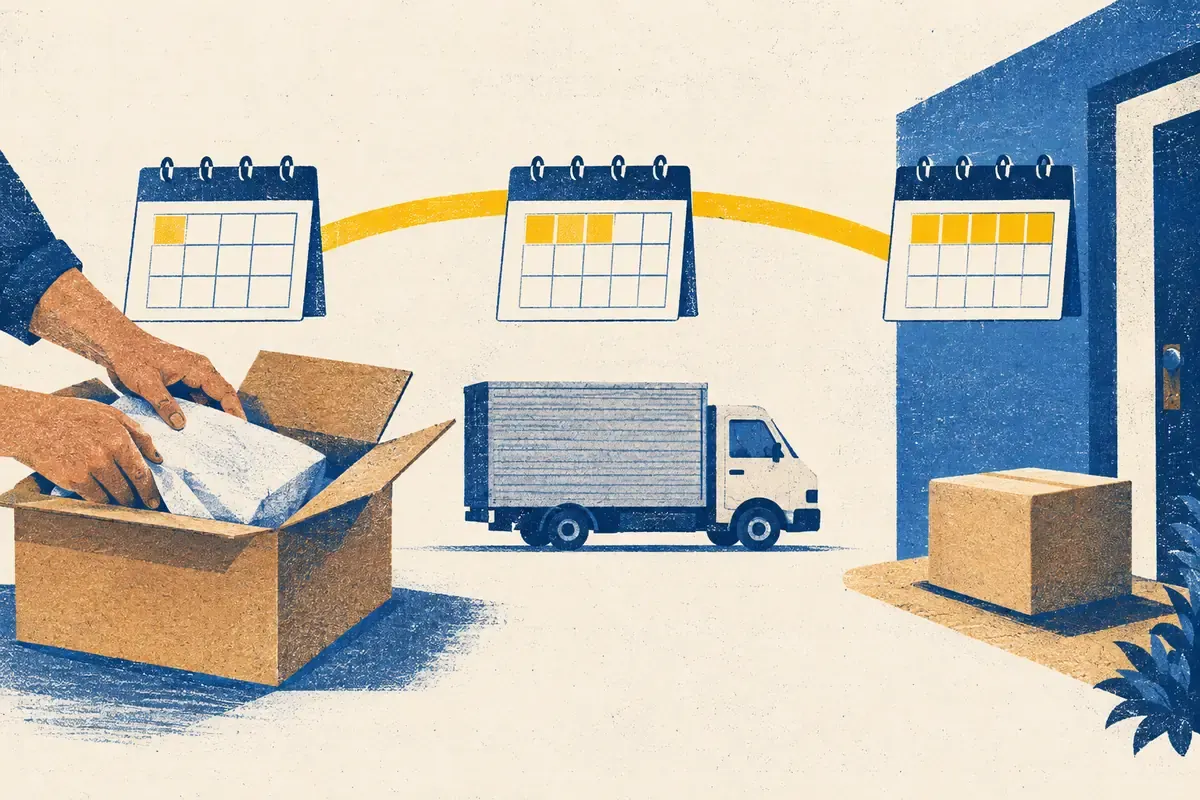
Photo: Avila Ops Tecnologia
Start with dispatch: time between approved payment and the package leaving your hands. If you pick once daily, one business day. Every other day, two. For boleto payment, add up to three business days for clearance before counting begins.
Then transit: the time carriers or Correios give for each postal-code band. It already uses business days and varies by region. Finally, a buffer: one business day in ordinary months, two or three during campaigns. It covers late-day orders, missed pickups, and postal codes served only weekly.
A São José do Rio Preto store dispatches in one business day, and Correios promises three business days to São Paulo city. With one buffer day, the published promise is “5 business days after payment approval.” On Black Friday, dispatch rises to two days and the buffer to three: “8 business days.” Other regions vary by postal code: the store adds dispatch and buffer to carrier transit for each destination and displays the result in shipping calculations. Nobody abandons a purchase because of three extra days; many refuse to buy again after a delay.
How should you state delivery times in the store?
With a unit, starting point, and condition. “Delivery within 5 business days after payment approval” is clear. “Delivery within 5 days” says neither whether they are business days nor when counting begins. Put timing on product pages beside shipping calculations, repeating it at checkout and in confirmation emails.
For made-to-order products or different lead times, specify timing per product rather than globally. If offering in-store pickup, state that timing too: “ready for pickup in 1 business day.”
| Situation | Wording |
|---|---|
| Own stock, ordinary month | X business days after payment approval, with X calculated by postal code |
| Own stock, Black Friday | X + 3 business days after payment approval |
| Made to order | 15 business days, produced after payment |
| In-store pickup | Ready in 1 business day, WhatsApp notification |
What should you do when you will miss the deadline?
Notify customers before they ask. A late order with a message on the day the delay is discovered produces understanding. The same delay discovered by customers produces complaints. The store must know daily which orders are approaching deadlines and which have passed them; a simple system list works.
This also affects carrier choice: one that runs late and disappears is more expensive than one charging R$ 2 more and responding. The guide how to choose a carrier covers criteria, and order picking explains maintaining one-day dispatch even at peak times.
What to do now
Measure your last 20 orders from payment to dispatch and dispatch to delivery. Add a buffer and compare with store wording. If the published promise is shorter than reality, correct it today and set campaign timing now. If your system does not show late orders, we help you leave spreadsheets without losing history: avilaops.com/sistema-para-pequenas-empresas or contact us on WhatsApp: wa.me/5517997811471.
Frequently asked questions
Does delivery time start with the order or payment?
Approved payment. Pix approves immediately, cards in minutes, boletos within 3 business days. State this so boleto customers do not count from order day.
What happens if the store delivers late?
Under Article 35 of the Consumer Protection Code, customers may demand fulfillment, accept another product, or cancel with a full refund. They can also complain to Procon. Proactive notice reduces cancellations.
Is promising short delivery worthwhile for more sales?
Only if you deliver on it. Missed short promises create cancellations, chargebacks, and public complaints. Realistic timing with early arrival creates repeat purchases.
Connections, made clear
Every delivery has a journey to follow.
Explore a transport operation and its review points.
- RequestGather collection or delivery details.
- PlanningOrganise the stops and responsibilities.
- DispatchCheck the load and record its departure.
- TrackingMonitor updates and possible incidents.
- CompletionReview the delivery and operation records.
- Request. Gather collection or delivery details.
- Planning. Organise the stops and responsibilities.
- Dispatch. Check the load and record its departure.
- Tracking. Monitor updates and possible incidents.
- Completion. Review the delivery and operation records.
Request
Gather collection or delivery details.
Turn what you learned into your next step.
Tell us about your company and what you want to improve. We can explore the right tools, integrations or custom project together.